
On September 29, 2026, the AWS Architecture Blog published a technical how-to for adaptive interfaces: the AG-UI protocol, a Strands Agents swarm, and Amazon Nova Act. This AG-UI protocol agent swarm architecture diagram is that reference architecture, not a medical product and not a measured case study. The post uses a radiology assistant only as its example of variable model output. The picture is React with Amazon Cognito, Amazon API Gateway server-sent events, a Lambda AG-UI handler, Amazon Bedrock AgentCore Gateway, a Strands swarm on Amazon Bedrock, and a dashed Nova Act path that drives a legacy Radiology Information System through its browser. Facts follow only that article.
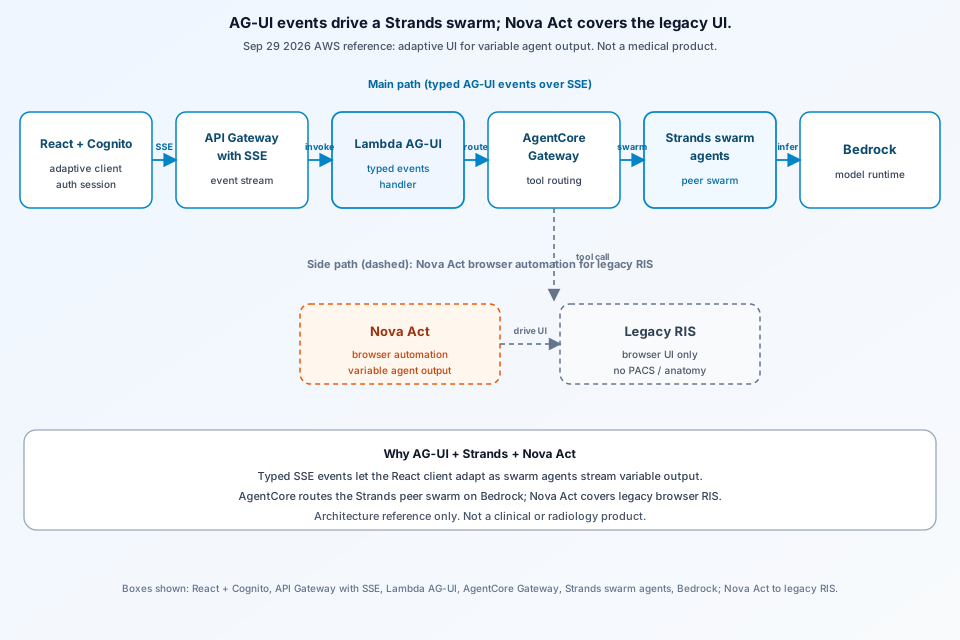
What this AG-UI protocol agent swarm architecture diagram shows
The picture shows one client entry and one agent the UI talks to. The post’s frontend is a React app signed in with Cognito. Static assets come from Amazon CloudFront and Amazon S3. API Gateway carries both REST calls and a server-sent event stream. Lambda is the AG-UI handler: it checks the caller, invokes agents through Bedrock AgentCore Gateway, and writes the SSE stream. AgentCore Runtime runs a Strands swarm. Amazon Bedrock is the foundation-model call. Off to the side, dashed, Nova Act automates a legacy hospital RIS or EMR web UI. The post says the sample code is educational. It is not a product you deploy as a diagnostic device.
The problem this architecture is solving
The post’s point is variable output. A static screen assumes the same fields every time. The radiology example is only there to show two different shapes of output: one obvious finding versus several regions the agents still disagree about. Before AG-UI, each agent framework needed its own socket format. AG-UI is the contract they describe: typed events on SSE, so the UI can change which components it shows without a new integration per framework. The post does not publish a build-time or quality metric.
Main components and trust boundaries
Cognito issues the token. The sample validates a JWT before the AG-UI route handles a request. The user sees one assistant. The post calls that an orchestrator. Inside, three peer agents share the work: image analysis, clinical reasoning, and reporting. They are peers in the Strands swarm pattern, not a supervisor handing off independent jobs. The sample reads the Bedrock model id from an environment variable and tells you to pick a model that is still current in your Region. Do not treat the sample model string as a permanent default.
Agents do not emit arbitrary HTML. The post says they choose from a fixed library, naming ROICard, DebatePanel, and ConfidenceMeter, so the UI can adapt without becoming an open page. AG-UI event names in the walkthrough include text streamed as the agent writes, state deltas, tool-call start and end, and a component spec. Session state, history, and findings sit in DynamoDB. Images sit in S3 with a customer-managed key, Block Public Access, and TLS. A knowledge base in the diagram is Amazon OpenSearch Serverless. Nova Act’s credentials come from AWS Secrets Manager at runtime. The post says not to place secrets or patient identifiers inside the natural-language act commands, and to use a sensitive text entry for passwords. CloudWatch holds logs and metrics, with data-protection policies. ADOT exports traces. The post says the listed AWS services are HIPAA-eligible and that a BAA is required before real patient data. That is a gate in the article, not a certification of this diagram.
Request or data path, step by step
The browser loads the React app and authenticates with Cognito. A request hits API Gateway. Lambda checks the token, then calls AgentCore Gateway. The gateway routes into AgentCore Runtime, where the swarm runs. Each agent calls Bedrock. As they work, the handler formats events and returns them on the SSE response. The client switches on event type and either appends text, updates state, or mounts a known component. The post also describes the UI sending state back so an agent can pause for a person before it continues. That is the human-in-the-loop edge, not a second swarm.
When the reference flow files a report into a system that has no API, Nova Act opens the legacy web UI. The post’s sample retrieves a secret, signs in through the browser, searches a record, fills a form, and reads a confirmation. Each of those actions is streamed back so the main UI can show the automation. That route is a dashed side path from the agent tier to the legacy RIS browser only. It is not on the path from Cognito to Bedrock, and it is not a medical device.
The diagram: labeled boxes and failure or isolation edges
Boxes, in order: React + Cognito, API Gateway SSE, Lambda AG-UI, AgentCore Gateway, Strands swarm agents, Bedrock. Dashed side path: Nova Act to a legacy RIS browser UI only. Isolation edges: JWT before any event that could carry sensitive text; secrets never rendered into the page; agents limited to the component library; Nova Act outside the model call. Failure edges the post actually discusses: an agent error event in the stream, debate that ends without consensus and is shown as disputed, and a legacy UI that can only be driven through the browser. The article does not publish a timing budget or a quality score.
What the source does not claim
This is a September 29, 2026 technical how-to. The radiology story is the authors’ reference scenario. It is not a shipped medical product, not a clinical study, and not a case study with outcomes. Sample consensus rules in the code are example control flow, not a measured diagnostic threshold, so they stay off this diagram. The post does not claim a generally available healthcare application.
FAQ
What does AG-UI standardize in this reference?
The September 29, 2026 post says AG-UI is a standard format of typed events streamed over server-sent events. Agent frameworks emit the events and the frontend consumes them, so you are not writing a custom socket format for each framework. The walkthrough names text content, state deltas, tool-call start and end, and a UI component spec.
How is the Strands swarm different from one agent here?
The post uses the Strands swarm as peers that share hypotheses and refine them until they agree or the round limit in the sample ends. The UI still sees one orchestrated assistant. The three sample roles are image analysis, clinical reasoning, and reporting. The radiology story is the post’s example of variable output, not a medical product.
What is Nova Act doing on the side path?
Amazon Nova Act drives a legacy web UI with natural-language browser steps when the system has no API. In the reference, that is a hospital RIS or EMR screen. Credentials come from Secrets Manager and are not placed in the prompt. The post says to stream each browser action back to the main UI. It is a side path, not the route from API Gateway to Bedrock.
Conclusion
Keep the September 29, 2026 reference in one line: React + Cognito, API Gateway SSE, Lambda AG-UI, AgentCore Gateway, a Strands swarm on Bedrock, and a dashed Nova Act path to a legacy RIS browser only. See the AWS Architecture Blog post. More diagrams are on the ByteDiagram blog.
Diagram an adaptive agent UI
Map Cognito, the SSE handler, the Strands swarm, Bedrock, and the dashed Nova Act path to a legacy browser in ByteDiagram.
Open Diagram Editor