
In late September 2026, Google Cloud previewed PostgreSQL for agents in AlloyDB — a shape built for a familiar fear: what happens when a burst of AI agents hammers the same Postgres cluster that runs your business? Coverage from Database Trends and Applications (Sep 25) and a technical read from Datapace (Sep 25, sourcing Google’s Sep 24 posts) describe the same bet. This AlloyDB agentic database architecture diagram walks it: agents reach an ephemeral pool of read-only microVM AlloyDB nodes that read fresh production state from separate Colossus segments, while apps keep writing to a production primary that does not share agent compute. Treat scale slogans (“thousands,” even “millions”) as preview marketing. This is preview only — not GA.
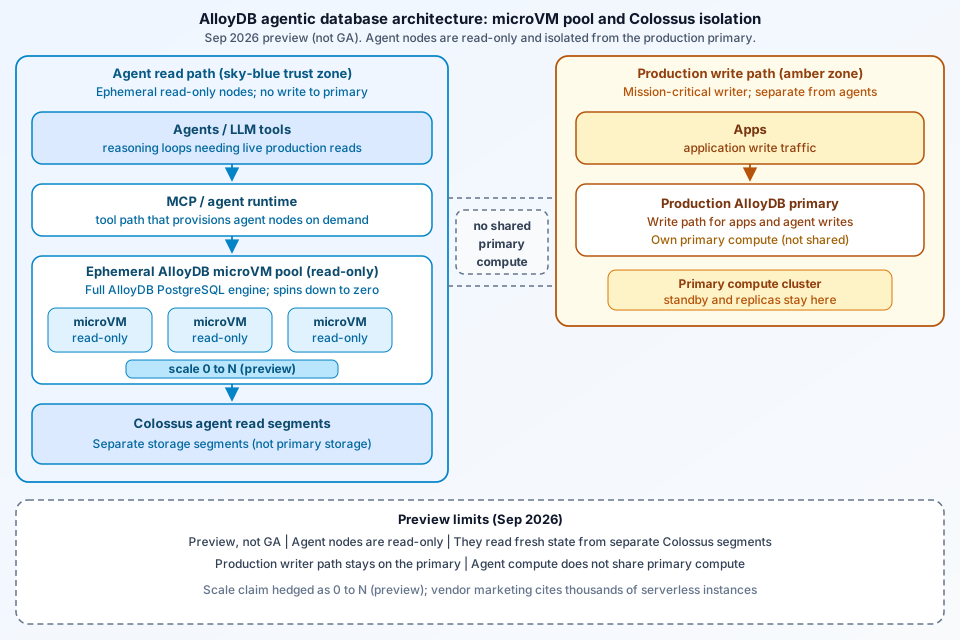
What an AlloyDB agentic database architecture diagram shows
Draw two swimlanes, not one fat cluster with “agents” as a sticky note. On the agent side: LLM tools and agent runtimes enter through a control path (Datapace summarizes this as MCP into an ephemeral pool), land on short-lived AlloyDB Postgres engines in lightweight microVMs, and read from Colossus segments reserved for agent I/O. On the production side: applications keep using the ordinary AlloyDB primary (with its standby and read replicas) for transactional writes. The diagram’s job is to make the isolation boundary visible — compute and storage for agents are not a shared fate with the writer path.
Label the microVM box read-only and stamp Preview near the scale callout. The architecture answers “will a thousand agents take down my primary?” more cleanly than classic replica spin-up. It does not answer “may this agent see that table?” or “who approved the write?” — those stay outside the sandboxed pool.
Why agents need ephemeral read-only Postgres nodes
Agent reasoning loops are bursty. They interrogate schemas, sample rows, run aggregates, join lakehouse context, and issue many small operational queries on the way to a conclusion. Pinning that pattern onto the primary — or onto a replica that still shares storage fate with production — turns exploration into a capacity and blast-radius problem. Independent replicas can isolate compute but often fail elasticity: rehydrating large storage takes hours while agent bursts are measured in seconds. Shared-storage replica designs can stay fresh but compete for the same storage bandwidth as the primary.
AlloyDB’s preview bet, as DBTA and Datapace both stress, is read-only nodes that appear when agents ask, expose a full AlloyDB PostgreSQL engine (indexes, SQL, vector / full-text / spatial search), and disappear when the loop ends. Writes an agent eventually wants still leave the sandboxed pool and hit the production write path — with all the old approval, locking, and rollback questions intact. Isolation protects production throughput; it does not govern meaning or entitlement of the data agents read.
MicroVM pool: scale from zero without touching the primary
On the diagram, the agent fleet is a pool, not a permanent replica tier. DBTA reports sandboxed instances provisioned in seconds for dynamic agent bursts, fully separated from primary, standby, and read replica instances where production workloads run, then scaled back to zero when agents finish — billing framed around active reasoning loops rather than idle replica capacity. Datapace adds the engineering picture: each node is a full AlloyDB Postgres engine inside a lightweight microVM, provisioned on demand and billed per second of activity.
Google’s materials talk about scaling PostgreSQL to thousands of serverless database instances (and broader “millions of agents” messaging in the same news cycle). Hedge those as preview marketing until you can reproduce them in your own project. The architectural claim that matters for a review diagram is shape, not the peak QPS slide: scale from zero to N and back without cloning the primary compute path.
Colossus isolation: separate segments for agent reads
AlloyDB already stores data in Colossus, Google’s exabyte-scale distributed storage. The agentic twist is not “agents also read Colossus” — production already does. The twist is a separate set of Colossus segments for agent reads, spread away from the production data path so isolation extends through storage instead of stopping at compute. Datapace calls this the load-bearing difference versus disaggregated designs where replicas share storage servers (and bandwidth fate) with the primary.
Vendor claims attached to that path include up-to-the-second read-only freshness, sub-millisecond I/O, terabit-per-second aggregated scan throughput, and multi-million QPS figures on friendly index-lookup workloads. Cite them as Google preview numbers — Datapace notes they have not been independently reproduced — and do not invent your own latency or node counts. On the diagram, a dashed box around “Colossus agent segments” beside a distinct “production Colossus / primary path” is enough to teach the boundary.
MCP and tool path into agent nodes (high level)
Keep this lane thin. Agents and LLM tools do not SSH into Postgres; they go through an agent runtime that can provision and attach to the ephemeral pool. Datapace summarizes Google’s deep dive as agents connecting over the Model Context Protocol (MCP) into that pool. On an architecture diagram that is one arrow — Agent / tools → MCP or agent runtime → microVM AlloyDB nodes — not a full MCP gateway product tour. The interesting contrast is database-native agent nodes versus bolting agents onto API-tool gateways alone: here the isolation story is Postgres compute and Colossus segments, not just tool authorization.
Once attached, each node offers the full AlloyDB SQL surface for exploration, including hybrid search and lakehouse analytics hooks (BigQuery / Spark without a separate ETL project, per DBTA’s summary of Google’s announcement). That breadth is why the read-only label matters: powerful reads, sandboxed away from the writer.
Production primary vs agent fleet (side-by-side)
Put the two paths next to each other so reviewers cannot collapse them into “AlloyDB with agents”:
- Apps → production AlloyDB primary — transactional writes, standby, classic read replicas; the mission-critical path. Agent writes that mutate state still land here after leaving the sandbox.
- Agents → MCP / runtime → ephemeral microVM pool (read-only) — short-lived full Postgres engines that read from Colossus agent segments and scale to zero.
DBTA quotes Manhattan Associates on using the architecture so networks of agents can analyze inventory and order data with sub-second freshness while core transactional processing remains untouched. That customer framing matches the diagram’s point: isolation and freshness for agent reads, not a shared primary compute path. Add an explicit callout: no shared primary compute.
Preview limits and what not to assume
Is (preview): an AlloyDB agentic database architecture where ephemeral read-only microVM nodes read production state from separate Colossus segments; scale-from-zero messaging; MCP/runtime path into the pool; full AlloyDB Postgres capability on those nodes; billing framed around active agent-node time.
Is not: generally available product; a claim that agent writes are sandboxed the same way; a guarantee of any specific QPS, IOPS, or “thousands of nodes” in your region; automatic governance over which tables an agent may see; or independently verified benchmark numbers. Per-second rates were not published with the preview materials Datapace reviewed — access itself goes through Google’s preview process. Draw Preview on the diagram so architecture reviews do not treat marketing peaks as capacity planning inputs.
FAQ: AlloyDB agents, Colossus, and microVMs
What is PostgreSQL for agents in AlloyDB?
A September 2026 Google Cloud preview that gives AI agents ephemeral, read-only AlloyDB PostgreSQL nodes. Those nodes spin up in seconds, read up-to-the-second production state from separate Colossus storage segments, stay fully separated from primary / standby / replica compute, and scale back to zero when agents finish. Not GA.
Why do agent nodes use separate Colossus segments?
So agent I/O does not share fate with the production storage path. The agentic architecture serves agents from their own Colossus segments, extending isolation through storage rather than stopping at compute. Vendor materials also claim sub-millisecond I/O and very high aggregate scan throughput on that path — treat those figures as preview marketing until independently reproduced.
How do agents connect to AlloyDB microVM nodes?
At a high level, agents and LLM tools reach an agent runtime (commonly described via MCP) that provisions nodes from an ephemeral microVM pool. Each node runs a full AlloyDB PostgreSQL engine in read-only mode. When the reasoning loop ends, instances scale to zero. Writes still go through the production write path — not the sandboxed agent pool.
Conclusion
Draw the isolation story: agents / LLM tools → MCP or agent runtime → ephemeral read-only AlloyDB microVM pool → Colossus agent segments, beside a separate apps → production primary write path, with callouts for Preview, read-only, no shared primary compute, and scale 0→N hedged as marketing. Cite DBTA’s news flash and Datapace’s architecture read for the Sep 24–25 preview framing — and keep governance and writes on the diagram as open questions the storage design deliberately leaves alone. Browse more architecture diagrams on the ByteDiagram blog.
Diagram AlloyDB agent nodes vs the production primary
Map agents through MCP into an ephemeral read-only microVM pool reading separate Colossus segments, then contrast the apps → primary write path in ByteDiagram — and stamp Preview on the scale callout before your next architecture review.
Open Diagram Editor