
On September 29, 2026, MongoDB announced Atlas Infinite at Investor Day — the largest architectural change to MongoDB Atlas since the managed service launched in 2016. Alongside MongoDB 9.0 (generally available) and Atlas Agent Engine, Infinite introduces a new cluster edition that separates compute from storage so each layer can scale on its own terms.
This guide shows what to draw on a MongoDB Atlas Infinite architecture diagram: apps and agents → anonymous Atlas endpoint → elastic compute (replica set + isolation nodes) → disaggregated durable storage → a dashed Atlas Core contrast box for coupled nodes. For classic edge caching paths, keep a separate CDN architecture; for L4/L7 front doors, see the load balancer patterns guide. This post is about database elasticity, not GPU inference routing.
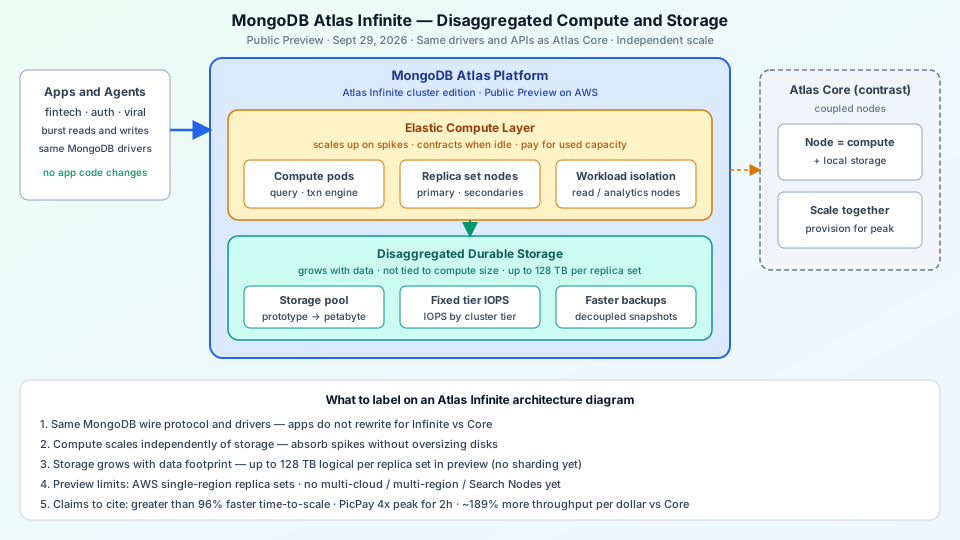
Why coupled clusters struggle with bursty demand
Traditional Atlas clusters (now branded Atlas Core) place query compute and durable storage on the same nodes. When traffic spikes — a fintech settlement window, a viral launch, or thousands of agents issuing tool-driven reads and writes — teams usually scale the whole node tier. Disk capacity, IOPS, and CPU grow together even if only one of them is the bottleneck. The alternative is over-provisioning for peak and paying for idle capacity the rest of the day.
Agentic workloads make that mismatch worse: one user action can fan out into planning, retrieval, and many database operations. Demand becomes quieter one minute and enormous the next. Atlas Infinite’s answer is disaggregation: grow compute when the query engine needs it, grow storage when the data footprint needs it, and stop forcing those two decisions to be the same resize ticket.
Architecture layers to draw
| Layer | What it is | Diagram tip |
|---|---|---|
| Clients | Apps, services, AI agents | Left: same MongoDB drivers / wire protocol |
| Atlas platform | Managed control plane + cluster edition | Blue shell labeled “Atlas Infinite” |
| Elastic compute | Query/txn engine, replica set, isolation nodes | Amber band; arrows up/down for scale |
| Disaggregated storage | Durable pool separate from compute size | Teal band under compute; vertical link |
| Atlas Core contrast | Coupled compute + local storage nodes | Dashed gray box on the right |
| Preview limits | AWS, single region, replica sets only | Footnote band — do not claim GA multi-region |
Atlas Infinite vs Atlas Core
MongoDB renamed the existing managed offering to Atlas Core. Core and Infinite are now two deployment options inside one Atlas platform. Customers can use one or both depending on workload shape. Adopting Infinite does not require application rewrites: the same drivers, APIs, security posture, and operational tooling apply.
| Dimension | Atlas Core | Atlas Infinite (Public Preview) |
|---|---|---|
| Compute ↔ storage | Coupled on each node | Independent layers |
| Scaling model | Resize / add coupled capacity | Scale compute or storage separately |
| Pricing intent | Provisioned capacity mindset | Consumption-oriented compute + storage |
| Cluster shapes | Replica sets, sharding, multi-region, Search Nodes | Replica sets only; AWS single-region; no Search Nodes yet |
| Data growth story | Shard when a replica set is too large | Up to 128 TB logical per replica set in preview |
Diagram rule: draw Infinite as two stacked bands (compute over storage). Draw Core as one node card that contains both CPU and disk icons — that visual contrast teaches the architecture in one glance.
What MongoDB claims for elasticity
Cite the Investor Day / PR numbers carefully and label them as vendor-reported:
- Time to scale — more than 96% faster time-to-scale versus prior Atlas scaling behavior (MongoDB announcement).
- Throughput efficiency — internal tests with MongoDB 9.0 show about 189% more throughput per dollar than Atlas Core.
- Customer spike story — PicPay reported sustaining 4× normal peak traffic for two hours on Infinite with zero failures.
- Storage density — MongoDB states each shard (or large replica-set footprint in preview messaging) can hold on the order of 10× more storage relative to prior coupled sizing constraints; preview docs emphasize large logical capacity per replica set (up to 128 TB).
Pair those claims with MongoDB 9.0 engine gains (up to 2× throughput on large instances, ~35% faster find-one, ~30% faster update-one vs 8.0) when you need a “why now” annotation — Infinite rides on the new engine but is a distinct architectural product.
Request path to sketch
- Client issues reads/writes with existing drivers — no Infinite-specific SDK.
- Atlas networking terminates private or public access the same way Core does (security and compliance posture unchanged per MongoDB).
- Compute layer runs the query and transaction engine on replica-set nodes; optional read-only / analytics nodes isolate heavy scans from the primary’s OLTP path (same region in preview).
- Storage layer serves durable data from the disaggregated pool. Storage IOPS and throughput are tied to the chosen cluster tier (docs publish fixed IOPS/MBps tables per tier) rather than growing automatically with every gigabyte of data.
- Control plane handles backups/snapshots that benefit from the decoupled layout (customers call out faster backups as an operational win).
Public Preview limits to label honestly
Infinite is available in Public Preview on AWS first, with other clouds and Atlas for Government planned later. During preview you should annotate:
- Replica sets only — sharding remains an Atlas Core strength for now.
- Single-region deployment — no multi-region or multi-cloud Infinite clusters in preview.
- No Dedicated Search Nodes on Infinite during preview.
- Feature surface may change before GA — point readers at MongoDB’s Infinite landing / preview docs for the live matrix.
Draw those limits as a dashed footnote, not as solid production guarantees. That keeps architecture reviews honest when someone asks “can we fail over across regions on Infinite today?”
When to diagram Infinite (and when to keep Core)
| Prefer Atlas Infinite | Prefer Atlas Core (today) |
|---|---|
| Spiky agentic or event-driven OLTP where compute peaks diverge from data growth | Need multi-region, multi-cloud, or global clusters now |
| Want consumption-style elasticity without app rewrites | Need sharded topologies or Search Nodes in this cluster |
| Large single replica-set data footprint with bursty query demand | Regulated multi-region HA patterns already standardized on Core |
| AWS-only proof / preview evaluation | Non-AWS primary cloud today |
Pitfalls to annotate
- Preview ≠ GA — do not draw multi-cloud failover as live Infinite capability.
- IOPS still tier-bound — storage size can grow, but storage performance follows the cluster tier tables; changing IOPS means changing tier.
- Not a CDN or cache tier — Infinite does not replace edge caches; keep CDN diagrams separate.
- Agent Engine is adjacent, not the same box — memory/governance for agents is a sibling launch; put it outside the Infinite compute/storage bands unless the figure is explicitly a platform map.
- Migration expectations — MongoDB markets “no app changes,” but still plan capacity, backup, and observability validation in a staging project before cutting production traffic.
Example prompt for AI diagram generation
Drop this into ByteDiagram for a first draft that matches the hero figure:
Left: Apps/agents with MongoDB drivers (no code changes)
Center blue shell: Atlas Infinite — amber Elastic Compute over teal Disaggregated Storage
Right dashed: Atlas Core coupled node (CPU + disk together)
Bottom: preview limits AWS single-region replica sets; 96% faster scale; PicPay 4x peak
Left-to-right flow, vertical compute-to-storage arrow.
FAQ
Do I need new drivers for Atlas Infinite?
No. MongoDB states Infinite uses the same drivers, APIs, and operational tooling as Atlas Core, with the same security and compliance posture.
Is Atlas Infinite only for AI agents?
No. The launch narrative emphasizes agentic burstiness, but the architecture helps any workload where compute spikes and storage growth are poorly correlated — fintech peaks, viral launches, batch-plus-OLTP mixes.
How is this different from sharding?
Sharding (still a Core strength) splits data across many shards for horizontal scale-out. Infinite’s preview story is vertical elasticity via disaggregated storage under a large replica set, with independent compute scale. They solve related but different problems; do not draw them as synonyms.
Conclusion
Atlas Infinite is MongoDB’s September 29, 2026 answer for elastic operational data: keep the familiar Atlas APIs, split compute from storage, and absorb unpredictable demand without resizing disks every time CPU spikes. A clear MongoDB Atlas Infinite architecture diagram shows clients → Atlas Infinite (elastic compute over disaggregated storage) → honest Public Preview limits → a dashed Atlas Core contrast. Draw that once for platform reviews and capacity planning, then reuse it when comparing coupled clusters to independently scaled layers. For GPU-aware inference gateways rather than database elasticity, see the SageMaker HyperPod Inference Gateway guide.
Diagram your Atlas Infinite path
Generate a compute-over-storage Atlas Infinite layout in ByteDiagram, then contrast it with coupled Core nodes for architecture reviews.
Open Diagram Editor