
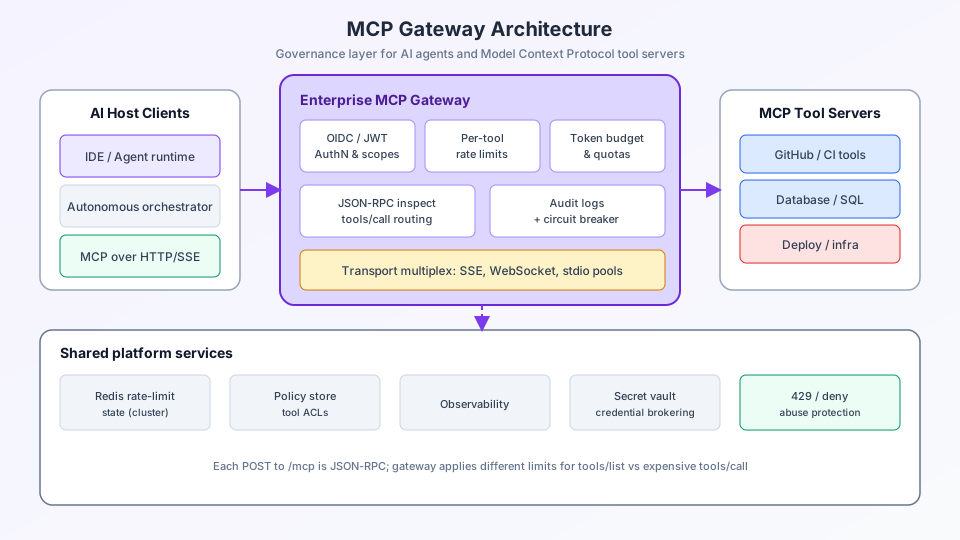
The Model Context Protocol (MCP) turned every IDE and coding agent into a client that can call real tools — databases, GitHub, deploy pipelines, and internal APIs. That power creates a new platform problem: direct agent-to-server connections do not scale for security, cost control, or compliance. An MCP gateway architecture diagram shows how you insert a governed reverse proxy between AI host clients and MCP tool servers, applying the same patterns API gateways used for REST — auth, rate limits, observability — to JSON-RPC tool traffic.
In 2026, vendors and platform teams are shipping MCP-aware gateways with per-tool throttling and token budgets. Whether you are designing for Cursor-style hosts or autonomous orchestrators, a clear diagram helps security, platform, and application teams agree on trust boundaries before agents get production credentials.
Why a gateway instead of direct MCP connections
Local stdio MCP servers work for a single developer laptop. Enterprise rollouts need:
- Central authentication — map human or service identity to agent sessions (OIDC, JWT, API keys with rotation).
- Tool-level authorization — allow
tools/listfor everyone but restrictexecute_sqlordeploy_serviceto privileged roles. - Cost and abuse controls — LLM-mediated loops can hammer expensive tools; per-tool rate limits and token budgets stop runaway spend.
- Auditability — every
tools/calllogged with user, agent, tool name, and outcome for SOC2 and incident review. - Transport normalization — multiplex HTTP/SSE, WebSocket, and pooled stdio backends behind one external endpoint.
Your diagram should make the gateway the only north-south path from agents to internal MCP fleets — similar to how an API gateway sits in front of microservices in classic system design.
Left column: AI host clients
Label the client tier with the runtimes you actually support:
- IDE-integrated hosts (editor extensions with MCP over HTTP/SSE).
- Headless agent frameworks running scheduled or event-driven workflows.
- Shared “agent pool” services that fan out tool calls on behalf of many users.
Show one arrow per transport into the gateway, not one arrow per backend server. Clients should not know individual MCP server hostnames in a mature architecture — they discover tools through the gateway’s catalog or routed namespaces.
Center: MCP gateway responsibilities
Group gateway functions into boxes your security team recognizes:
| Function | What to draw | Why it matters |
|---|---|---|
| AuthN / AuthZ | OIDC validator + scope injection | Prevents anonymous tool execution |
| Rate limiting | Per-tool counters + burst for session init | Stops expensive tools/call storms |
| Token budget | Leaky bucket per agent/session | Caps LLM context and downstream cost |
| JSON-RPC routing | Inspect method and params.name | Different rules for list vs call |
| Resilience | Circuit breaker, timeouts | Bad backends do not hang agents |
| Multiplexing | Connection pools to N MCP servers | Scale without N client configs |
MCP rate limiting is not “1000 req/s per IP.” Session startup firesinitialize,tools/list, and several probes — allow burst capacity, then tighten limits on high-risktools/callnames.
Right column: MCP tool servers
Draw each server as a bounded context: source control, data plane, infrastructure. Color-code risk — read-only introspection tools in cool tones, mutation and deploy tools in warm or red outlines. Arrows from the gateway to servers are east-west inside your trust zone; no client bypasses the gateway.
If you also expose REST APIs, note that MCP gateways complement — not replace — your existing API management layer. Many teams run both: REST gateway for mobile and web, MCP gateway for agent tool traffic, with shared identity and overlapping backend services.
Platform services beneath the gateway
- Distributed rate-limit store (often Redis) so every gateway replica shares counters.
- Policy / ACL service defining which roles may invoke which tool names.
- Secret brokering — gateway holds credentials; MCP servers never see end-user API keys from the agent.
- Observability — metrics on tool latency, error rate, and token usage; traces tying agent session ID to downstream calls.
Connect these with dashed lines from the gateway “policy engine” box downward so readers see control-plane vs data-plane separation — a layout familiar from Kubernetes cluster architecture diagrams.
Per-tool rate limiting on the diagram
Annotate example limits on the gateway edge:
tools/list— high ceiling (e.g. 120/min) for discovery.tools/callon read tools — moderate limits.tools/callondrop_table,apply_terraform, or deploy hooks — 1–5/min with break-glass approval.
Show HTTP 429 responses returning to the agent when limits trip, with a note that agents should backoff and surface errors to the user instead of retrying blindly.
Relating MCP gateways to RAG and retrieval stacks
Agents often combine MCP tools with retrieval. In documentation, place your RAG architecture diagram beside the MCP gateway diagram: RAG handles grounded knowledge; MCP handles actions. The gateway should still rate-limit embedding-heavy tools if they are exposed as MCP servers.
Example diagram prompt
Enterprise MCP gateway between Cursor-style IDE clients and internal MCP servers.
OIDC login, JWT scopes injected into tools/call.
Per-tool rate limits: list tools 120/min, SQL execute 2/min, deploy 1/min with 2FA role.
Redis-backed global rate limit, audit logs to SIEM.
Three MCP backends: GitHub tools, read-only Postgres, infra deploy (red zone).
Show 429 path and circuit breaker on unhealthy deploy server.
FAQ
Is an MCP gateway the same as an API gateway?
Conceptually yes — reverse proxy, auth, limits, observability. MCP gateways add JSON-RPC awareness: parsing tools/call bodies, tool catalogs, OAuth flows for MCP hosts, and token-cost tracking that plain HTTP gateways may not understand without custom plugins.
Can I rate limit only expensive tools?
Yes. Production configs use descriptors on MCP method and tool name so initialize and tools/list stay fast while dangerous tools get strict ceilings. Document those rules on your architecture diagram so agent authors know expected 429 behavior.
How do I present this to non-engineers?
Use left-to-right flow: “AI assistant” → “security checkpoint” → “company tools.” Animate tool calls in sequence for exec reviews — the same approach as ByteByteGo-style animated diagrams.
Conclusion
MCP gateway architecture is the control plane for agentic AI in production: one front door, consistent identity, per-tool guardrails, and shared observability. A single diagram aligning clients, gateway policies, tool servers, and platform services prevents credential sprawl and makes rate-limit design explicit before agents touch real infrastructure.
Diagram your MCP gateway
Map AI hosts, gateway policies, and tool servers in ByteDiagram — then animate a tools/call sequence for your next platform review.
Open Diagram Editor